
Wrong Wishes
- Genre: Two-Player Competitive Deckbuilder
- Type: Proof-of-Concept Prototype
- Engine: Tabletop Simulator
- Iterations # 7
- Playtests # 6
Role: Game Designer
Composed of: Research and conceptualization, documentation, prototyping, and balancing.
Iterations Overview
Goal
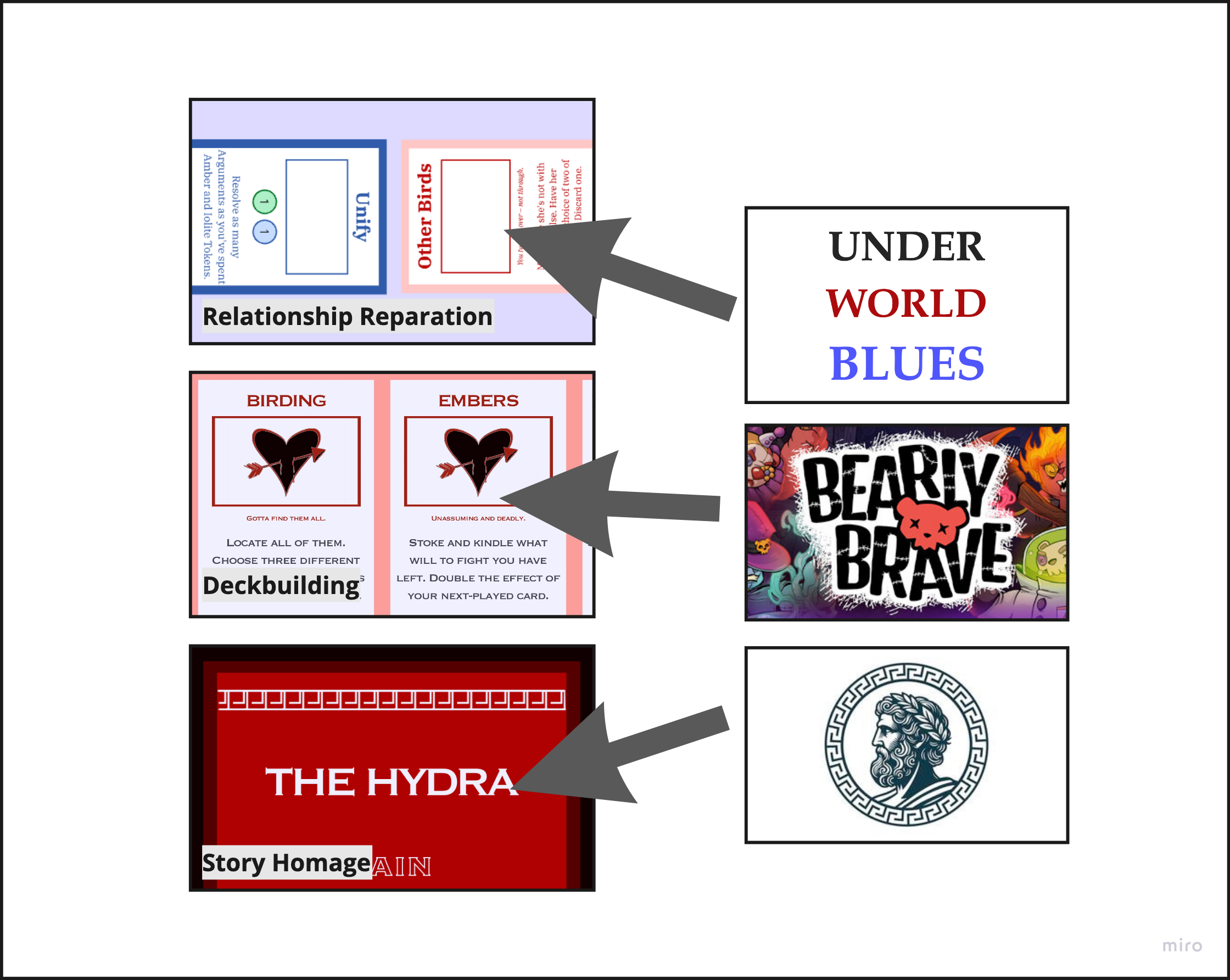
My goal for Wrong Wishes was to prototype mechanics for my future video game project Underworld Blues. At the same time, I wanted to accurately convey the tone and theme of Underworld Blues primarily through game design.
- Relationship Reparation: Wrong Wishes‘ theme of repairing damaged relationships had to be front and center in its mechanics.
- Deckbuilding: I adore deckbuilders like Bearly Brave and wanted to incorporate their adaptable mechanics into a linear narrative.
- Story Homage: Since Wrong Wishes is an adaptation, every part of it has to make sense within the context of Underworld Blues.
Throughout this process, I’ve sought regular feedback from Jeremiah Franczyk (LotR: Online), who helped me understand the sheer variety of mechanics that can be implemented in games.
Overview & Technique Highlights
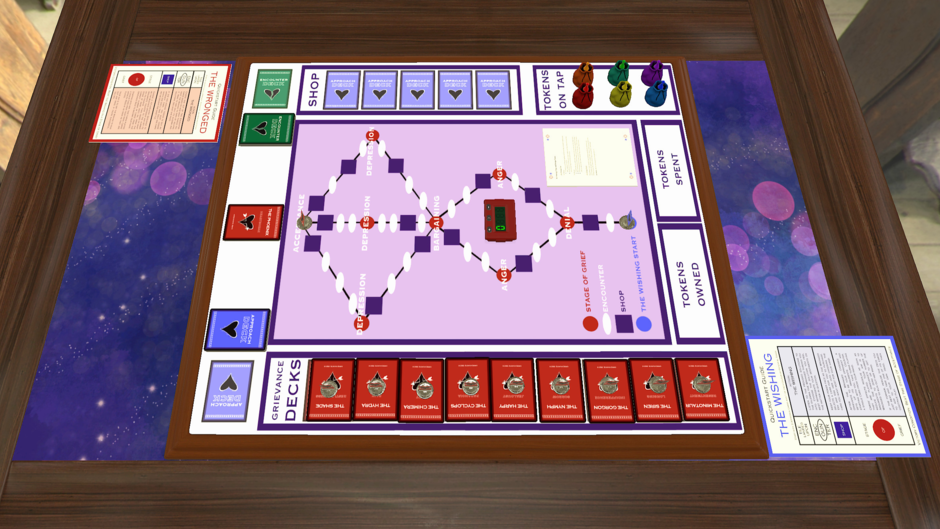
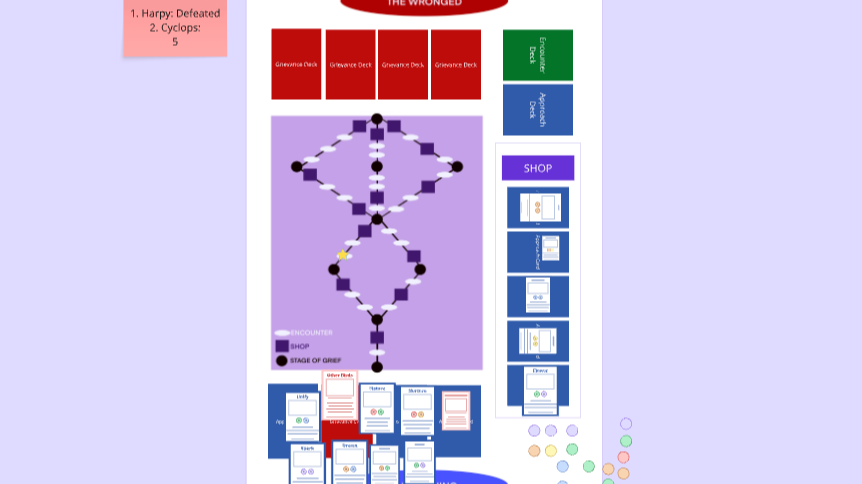
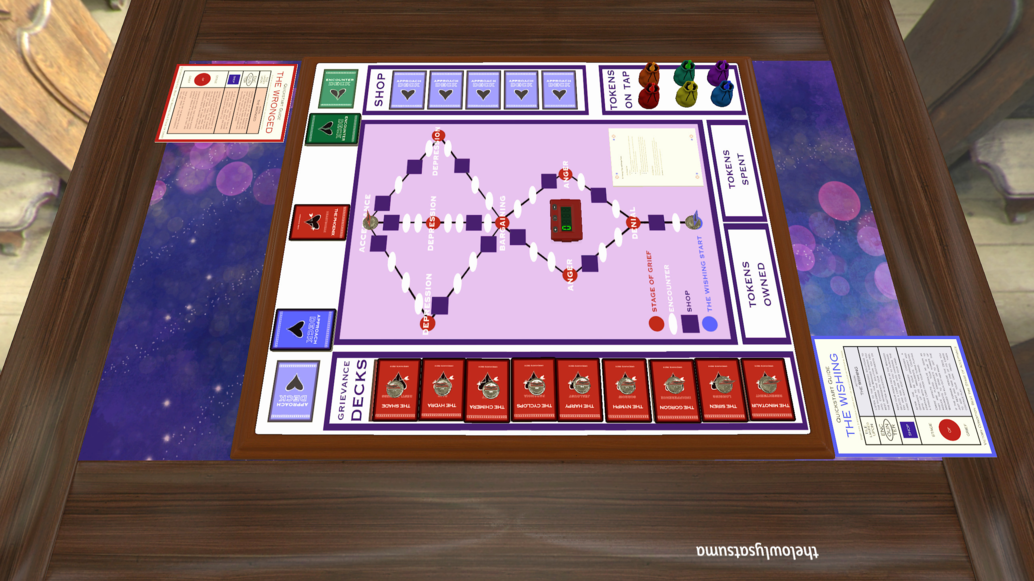
Game Premise: Players select their role: Wishing or Wronged. Each turn, the Wishing makes her way a little farther across the Timeline, using a deck of Approaches she builds herself to battle the Wronged’s Grievances in each of her Stages of Grief. Each turn, the Wronged sets a trap to exhaust the Wishing’s deck before she can reach the end of the Timeline.
The game ends when either the Wronged or the Wishing achieve their ultimate goal – disengagement and reconciliation, respectively.
Combining competitive deckbuilding mechanics with RPG narrative choices, two players must meet one another throughout various stages of life and try to either quash the grief entirely or fight like hell to work through it.
Technique Highlight 1: The Resolution of Cards
Goal: I wanted players to debate over what certain cards’ descriptions mean for them mechanically in order to create a feeling of antagonism.
Result: I obfuscated the Approach Cards’ text just enough so that they’d hold points of contention within them.
Techniques
- Did not clarify if certain card abilities occur at the top or the end of a player’s turn.
- Made it so the rules do not provide black-and-white guidelines for how cards may work.
- Allowed players to create their own compromises in order to augment the theme of sticky resolutions within a relationship.
Technique Highlight 2: The Shop of Enmity
Goal: I created an uneasy alliance (and a hesitantly open door) between players, forcing them to help one another out while in competition.
Result: I tweaked the Shops so the Wronged must buy cards there for the Wishing, using the Wishing’s resources.
Techniques
- Gave repeat Wronged players a way to intentionally “de-synergize” their next Grievance with the cards they purchase the Wishing.
- Made it so Wishing players would have to somewhat play around whatever strategy the Wronged decided to set for them.
- Allowed Wronged players to exert even more control over the board while still buffing their opponent.
Technique Highlight 3: The Ramping of Challenge
Goal: I increased the difficulty of combat for both players as the game goes on, thereby intensifying its challenge as it’s played.
Result: I granted each Stage of Grief custom rules to control the flow of an incrementally increasing challenge over the course of the game.
Techniques
- The Wishing player naturally gets stronger as the game goes on and they collect more and more Approach Cards.
- The Wronged player unlocks more card combat abilities as they go through each Stage of Grief.
- By the end of Wrong Wishes, both players should have powerful hands, leading to more intense victories and defeats.
Process Breakdown
1. Research, Ideation, & Theme
I knew I wanted to create a competitive game about the effects of grief on rebuilding relationships with a queer, magical realist theme.
- Analyzing Games: I took the map from various roguelikes such as Inscryption and Shogun Showdown as inspiration for my timeline, and I adapted the idea of Bearly Brave‘s gimmick bosses into my Grievances and their custom decks.
- Ideating Mechanics: I may have The Wishing steal a card from a Grievance’s deck to add to her hand after defeating it.
- Resonant Theming: For replayability and variety, I’ll need to create around ten Grievances. I plan on piggybacking off mythic concepts allegorical to relationship problems (ex: sirens) to quickly explain a Grievance’s deck and abilities.
2. Design Document: Rulebook
Premise: I started by figuring out my theme for Wrong Wishes, then found mechanics that would augment said theme. They included:
- Grievance Decks, which function as gimmick bosses.
- The ability for the Wishing to take a card from each Grievance she defeats.
- The ability for the Wronged to have control over the majority of adversity on the board.
Theme: I knew from the start that Wrong Wishes would be about repairing relationships, so the Stages of Grief as a thematic through-line seemed an obvious choice. The Greek mythology influence hails from the game Wrong Wishes is adapted from and based upon.
3. Prototyping
Paper Prototype
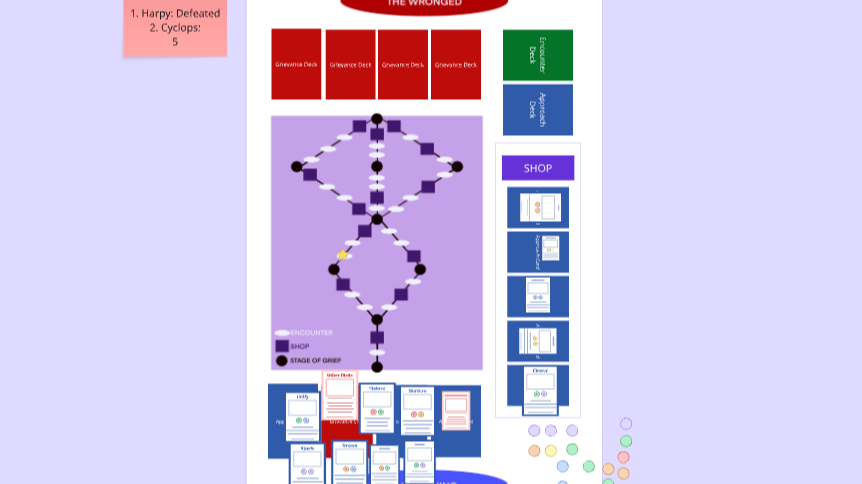
Result: Caught a problematic power imbalance exponentially favouring the Wishing. Adjusted for it.
Goal: To feel out the power dynamic between both players and re-balance it to fairness if necessary.
Solution:
- Limited the number of cards able to be purchased at each Shop tile to one.
- Boosted the number of cards the Wronged plays with in the further Stages of Grief.
- Powered up the Wishing so she can make it past the first Stage of Grief.
Rapid Prototype Highlight #1
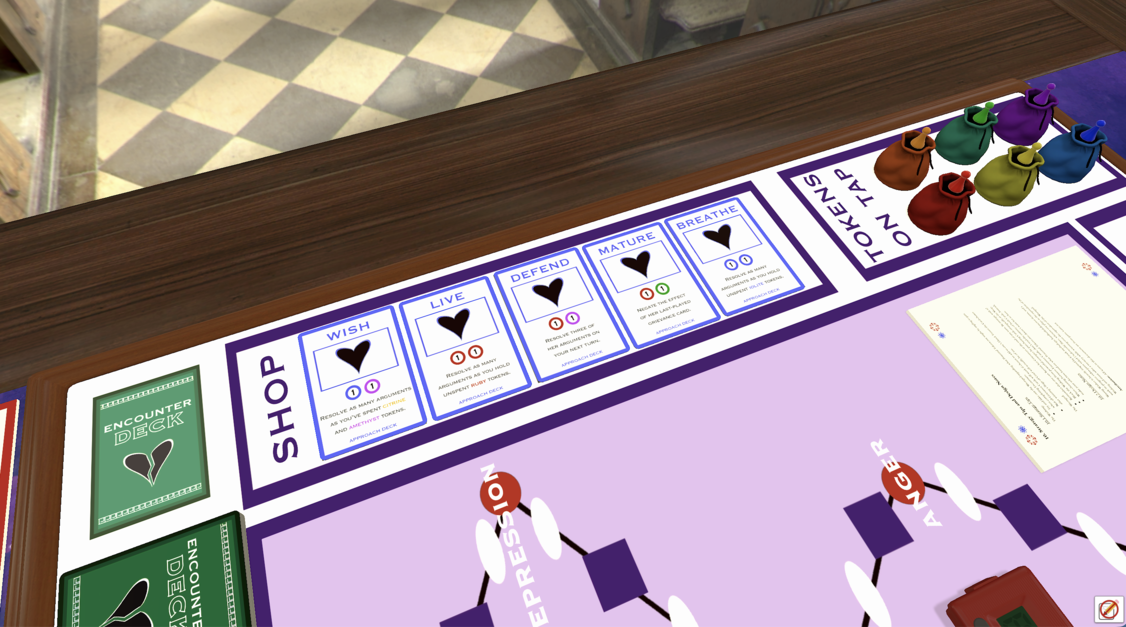
Result: Noticed an issue with the Wishing getting a high number of Potential Tokens she can’t use in Shops. Changed certain Approach Cards so as-of-yet unused Potential Tokens would power them up.
Goal: To ensure all pieces in play felt necessary and useful.
Solution:
- Added Approach Cards whose power depends on unused Potential Tokens.
- Made a space on the board for owned and for spent Potential Tokens.
Rapid Prototype Highlight #2
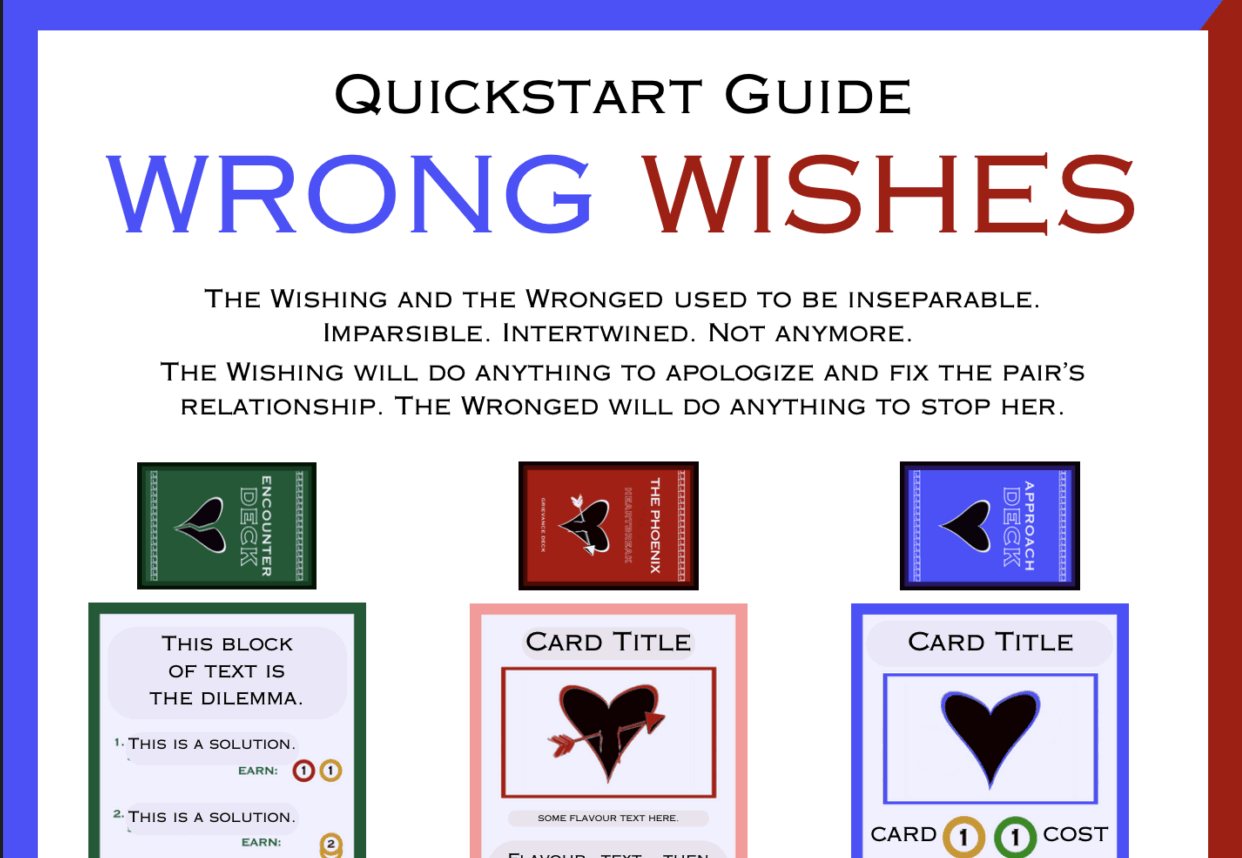
Result: Observed that the rules of the game were difficult to grok quickly from the Rules PDF alone. Made Quickstart Guides for the Wishing and the Wronged so they might have an easier time getting into the game.
Goal: To reduce time spent reading and arguing over the rules.
Solution:
- Created two Quickstart Guides – one for each player – that contain references explaining the most important pieces and rules of the game.
- Imported the Guides into Tabletop Simulator and placed them where each player ought to sit.
4. The First Interactable
Result: Balanced a two-player deckbuilder where one of the players doesn’t have health points to drain for a win condition.
Goal: Building a full playable prototype of Wrong Wishes in Tabletop Simulator with all cards’ flavour text completed.
Implementation:
- Mechanic Synergy 1: Stages of Grief as boss battles, where different combinations of luck of the draw and strategic plays simulate a sort of conversational combat.
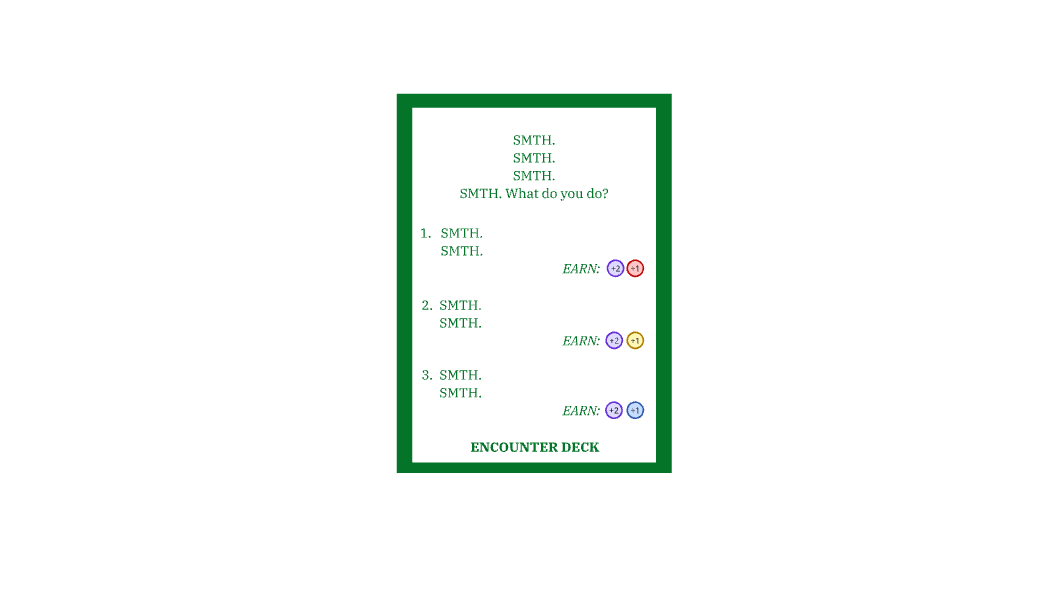
- Mechanic Synergy 2: Potential Tokens and the Encounter Deck represent chance opportunities that might happen, but are never certain to.
- Narrative Synergy: Greek mythology framework for the Grievances flavours those clashes as something both monstrous and sorrowful.
5. Playtest & Key Iterations
Playtest #1 Highlight
Result: Players had a lot of fun testing out various cards and their effects during the Stages of Grief.
Feedback & Problem: The pacing got slowed a lot by having to read through three Encounter Cards per Encounter.
Solutions: I amended the rules so now players only draw two Cards per Encounter, as well as encouraging the Wronged to choose Encounter Cards based on their Potential Token value rather than their flavour text.
Playtest #2 Highlight
Result: Players enjoyed embodying their roles — especially while playing as the Wishing.
Feedback & Problem: Players were confused about how Stages of Grief functioned, thereby missing a lot of the fun of the combat.
Solutions: I’ve clarified the rules regarding how the Arguments Counter works as well as making Quick Start Guides for both the Wishing and the Wronged.
Playtest #3 Highlight
Result: Players enjoyed the strong narrative theming and the Greek mythological influence.
Feedback & Problem: Some of the Grievance Cards were found to impede the player using them instead of aid them.
Solutions: I’ve gone through every Grievance Card and revamped the ones whose abilities were actually hindrances when played.
6. Polished Portfolio Piece
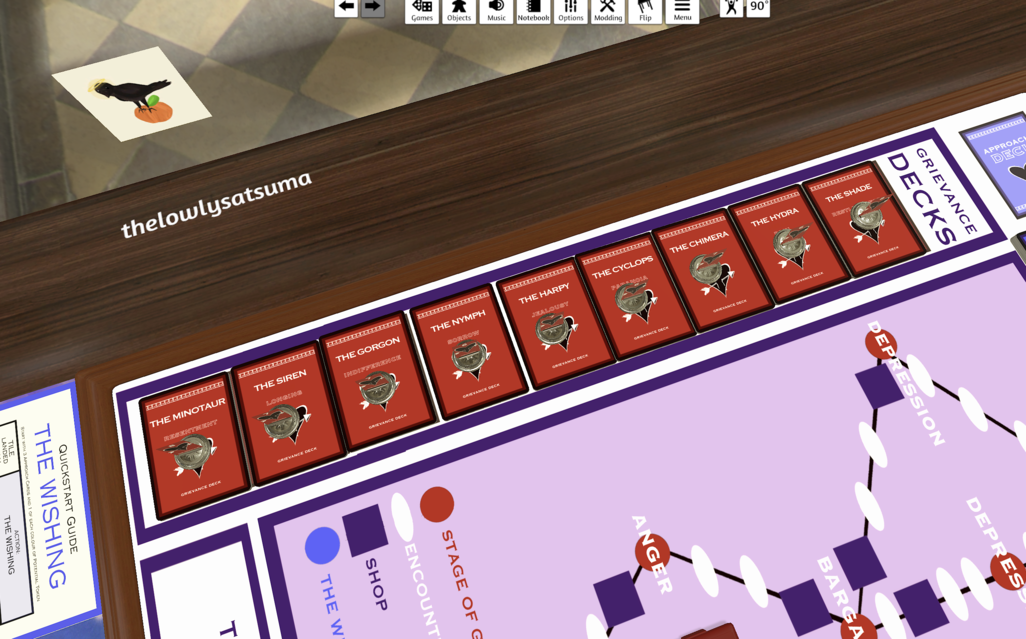
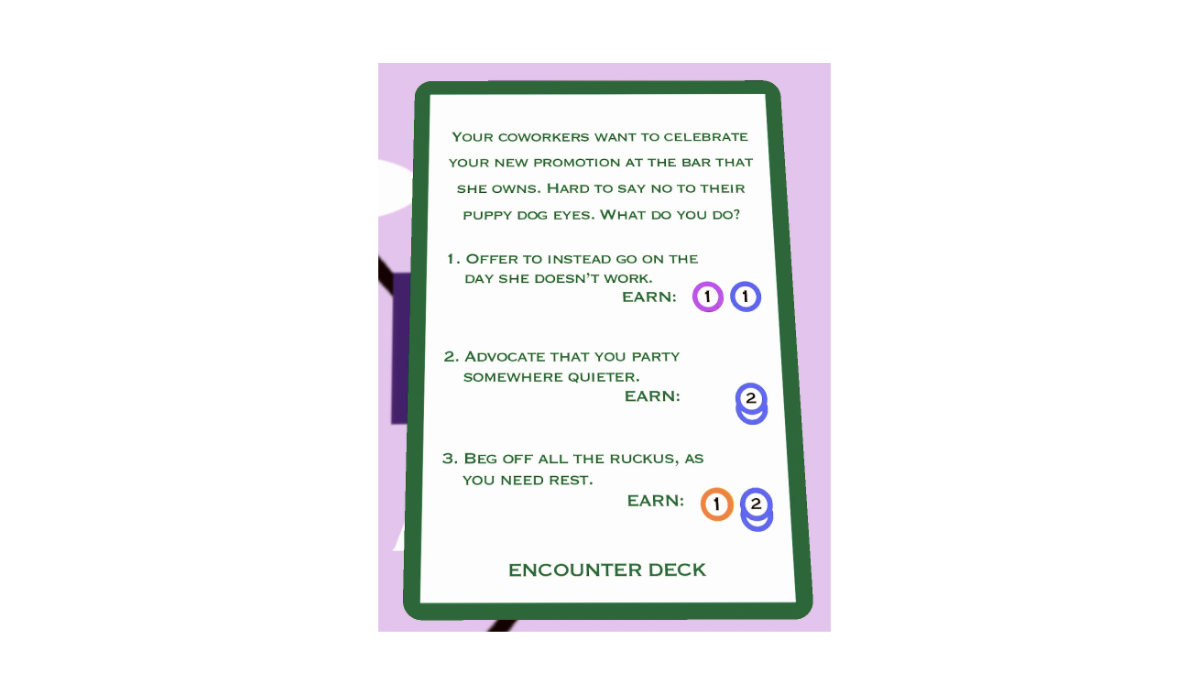
Results: Made a playable game on Tabletop Simulator.
Goal: Create a competitive two-player deckbuilder about the battle between distancing and reconciliation between two exes.
Execution:
- Deck Built By Her: Your opponent buys you the cards you’ll be using to defeat her.
- Replay Factor: No two games will have identical battles due to how the bosses ability are swapped out each run.
- Intentional Theming: Every piece in the game is carefully flavoured to align with the fantasy of winning back — or winning over — a heart.